Text by Ildeu Moreira, physicist and science historian and tenured member of the ABC
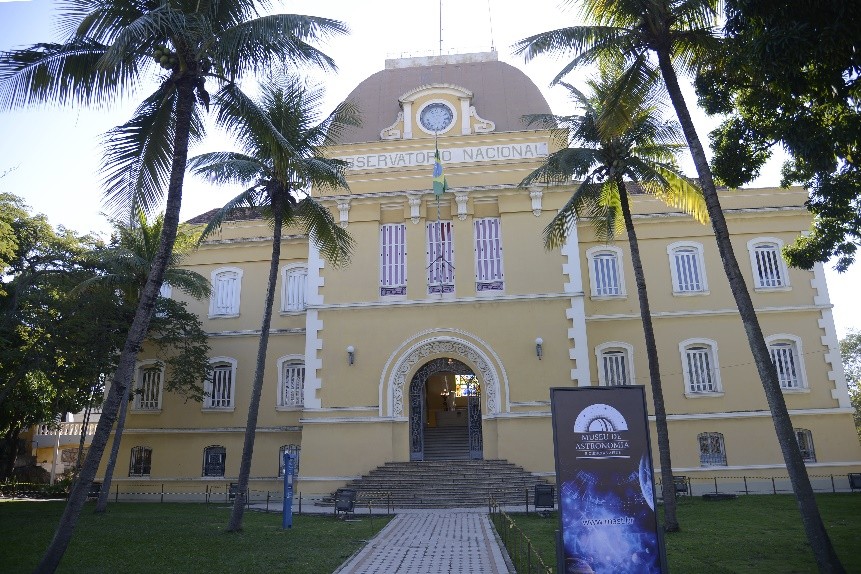
The eminent physicist Albert Einstein visited Rio de Janeiro between May 4 and 12, 1925. He gave two lectures on the Theory of Relativity — one at the Clube de Engenharia and another at the Escola Politécnica —, visited scientific institutions such as the National Observatory, the Oswaldo Cruz Institute, the National Museum and the Botanical Garden. Einstein also explored tourist spots in the city, was enchanted by the local nature, strolled through the streets, met with authorities and participated in events organized by the Jewish and German communities.
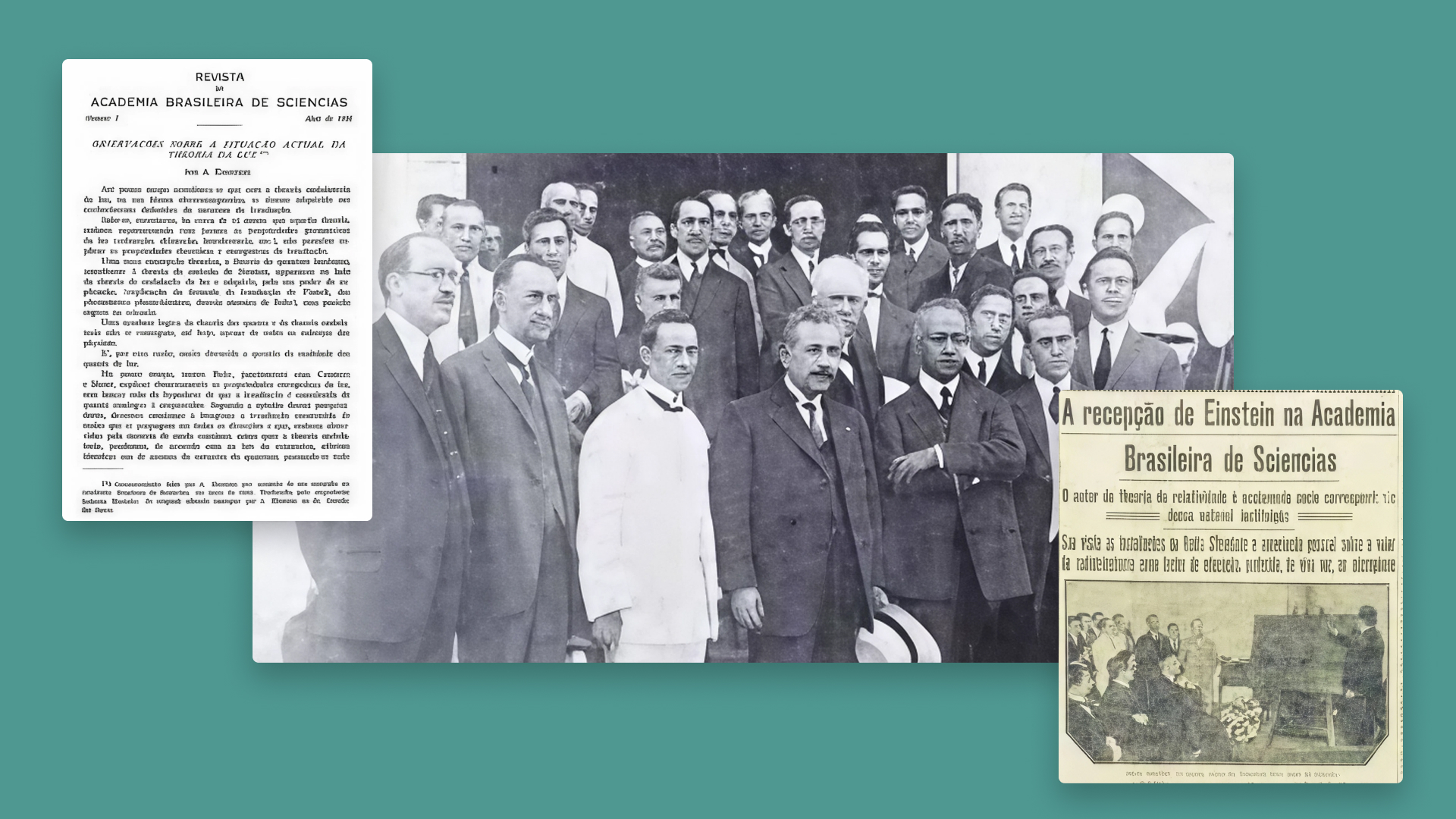
His presence at the Brazilian Academy of Sciences (ABC) was the most important scientific commitment of the visit to Rio. The solemn session in his honor took place on May 7 and brought together about 90 people, including academics, personalities and representatives of various institutions, including ten women. The event took place at the then headquarters of the ABC: the Czechoslovak Pavilion, on Avenida das Nações, which would be demolished in 1928. Juliano Moreira, then acting president of the ABC, opened the session, discussing the influence of relativity in various areas of science. He then presented Einstein with the diploma of Corresponding Member of the ABC, a title approved by acclamation.
Francisco Lafayette, a member of the ABC, gave a presentation on Einstein’s scientific work, highlighting his research on Brownian motion, the photoelectric effect and the theories of relativity. Then, Mário Ramos announced the creation of the Albert Einstein Award, which would be granted annually to the best work presented to the Academy.
Einstein then gave a brief, but historically relevant, lecture on the state of the theory of light. Instead of a formal speech, he presented the ABC with a crucial scientific question of the time: the problem of the reality of the quantum of light (the photon).
The three-page manuscript was written on paper from the Hotel Glória, where Einstein was staying. Dated May 7 – the same day as the conference – the document was written in German, although Einstein expressed himself in French during the event. The text was delivered to the ABC for translation and publication in its journal, which occurred in 1926.
The text of this communication was translated by Academician Roberto Marinho de Azevedo and published in the inaugural volume of the Revista da Academia Brasileira de Ciências, in 1926. This is Einstein’s only scientific article about his controversy with Niels Bohr regarding the nature of light quanta. The original manuscript remained in the possession of Getúlio das Neves and, later, was kept by his family members.
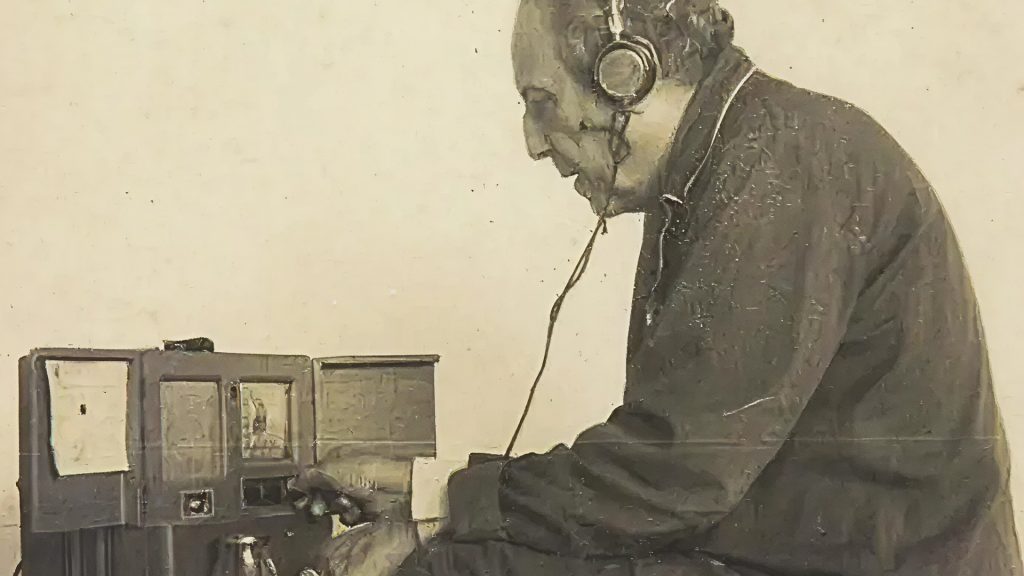
On May 7, during his visit to the Brazilian Academy of Sciences – headquartered in the Czechoslovak Pavilion, which also housed Rádio Sociedade (Brazil’s first radio station, founded by the ABC in 1923) – Einstein had the opportunity to listen to works of Brazilian music. The Rádio Sociedade orchestra performed: ‘Visões’, by Francisco Braga; ‘Batuque’, by Alberto Nepomuceno; ‘Magnífico’, tango by Ernesto Nazareth; and ‘Mulatinho’, choro by Belmacio Godinho. It was the latter, as reported by the newspaper A Pátria, that “most vividly impressed the great sage, provoking applause and exclamations of applause”.
Invited by Roquette-Pinto to say a few words to Brazilians through the microphone of Rádio Sociedade, Einstein accepted and spoke in German, his message being translated immediately by Mario Saraiva. “After my visit to this Rádio Sociedade, I cannot help but once again admire the splendid results achieved by science allied with technology, allowing those who live in isolation the best fruits of civilization. It is true that the book could also do and has done so; but not with the simplicity and security of a careful and heard live voice exhibition. The book has to be chosen by the reader, which sometimes brings difficulties. In the culture carried by radiotelephony, as long as qualified people are in charge of the disseminations, whoever listens receives, in addition to a judicious choice, personal opinions and comments that smooth the paths and facilitate understanding: this is the great work of Rádio Sociedade” [Einstein at Rádio Sociedade, May 7, 1925].
During his visits to the Escola Politécnica and the National Museum, Einstein heard many praises for the work of Cândido Mariano da Silva Rondon, a member of the ABC. At the National Museum, he had the opportunity to watch cinematographic records of Rondon’s expeditions – probably on the initiative of Roquette-Pinto, who had participated in an expedition with Rondon himself. The impression caused by these reports was so profound that, during his return trip to Germany, Einstein decided to nominate Rondon for the Nobel Peace Prize.
TO KNOW MORE
1. Moreira, I. C. and Videira, A. A. P. (Org.). Einstein and Brazil. Rio de Janeiro: Editora da UFRJ, 1995.
2. Moreira, I. C. and Tolmasquim, A. T. Einstein in Brazil: The communication to the Brazilian Academy of Sciences on the constitution of light. In: H. Kragh, G. Vanpaemel, P. Marage. (Org.). History of Modern Physics. Turnhout: Brepols Publishers, v. XIV, p. 229-242, 2002.
3. Moreira, I. C. and Tolmasquim, A. T. An original Einstein manuscript found in Brazil. Ciência Hoje, v. 22, n.124, p. 22-29, 1996.
4. Tolmasquim, A. T. Einstein. The Traveler of Relativity in South America. Rio de Janeiro: Vieira e Lent, 2003.
5. Carvalho, J. M and Moreira, I. C. (Org.). Science in Brazil – One Hundred Years of the Brazilian Academy of Sciences. Rio de Janeiro: ABC, 2017.